Friday, December 23, 2011

Merry Christmas!!!

MERRY CHRISTMAS EVERYONE!!

Not such a great year on the ASX this year, esp after the bull run.. however, merry Christmas.. Much love to all the visitors that come to this site each and every day!


Tuesday, October 25, 2011

News

Watching

Special dividend to be released:

Watching:


  • EXS
Will take a position in the next week or so, depending on overall market and technicals.. waiting for a pullback. Will be selling prior to the ex date

Monday, October 17, 2011

Watch

KeeP an eye out on:


  • CNN
  • GMM
I'm already watching!!

Thursday, October 13, 2011

Potential announcement expecting


SOURCE: http://hotcopper.com.au/post_threadview.asp?fid=287&tid=1569041&msgno=218250#218250

Wednesday, October 12, 2011

Article: RICK KAHLER: Can you time the market just right for a payoff?

ARTICLE: http://rapidcityjournal.com/business/rick-kahler-can-you-time-the-market-just-right-for/article_76b29308-ecad-11e0-b6dc-001cc4c002e0.html


Theoretically, timing the market could give you a huge payoff. At a recent conference I attended sponsored by Dimensional Fund Advisors, Walton Wellington, vice president of investment strategies, gave the following numbers.

Suppose, 70 years ago, you put $1,000 in a savings account. It would have grown to $16,000. If you had invested in the S&P Index and left it alone, you would have $1.8 million. If your holdings included an index with more than 3,000 companies, you would have $13.4 million.

However, had you perfectly timed the market, buying at the start of every bull market and selling at the top, you would have $7.2 billion. Conversely, had you sold before every bull market and bought at the top, you would have $3.40, enough for a cup of coffee at Starbucks.

No one can reliably predict the market. That includes the experts who are supposed to be able to do so. The stock-picking hall of shame is a crowded place.

In 1980, the U.S. experienced record high inflation and interest rates. I remember FHA mortgages at 14 percent, a prime rate of 20 percent and inflation topping 15 percent.

Gold was on a tear and real estate prices were escalating like crazy. The Dow was 759 and gold sold for $850 an ounce. Many mainstream publications announced that investments in paper assets like stocks were dead.

Instead, we began a 20-year bull market in stocks and a bear market in gold that would see gold dropping to $250 an ounce and the Dow Jones hitting 11,500. I remember it well. I owned gold and didn't own a single stock.

In 2001, P&I magazine polled a group of elite advisers, all of whom said 2002 would be a great year. It was another disaster. In 2002, Bill Gross, who runs the largest mutual fund in the world, said "stocks stink" and that the Dow was going to 5,000. In October of 2002, the Dow went up 969 points in four days and entered a new five-year bull market, closing at over 14,000.

In 1999, economic researcher Harry Dent wrote a book predicting we were about to enter a golden era of investing. He said the Dow Jones Industrial average would be 44,000 by 2008. Instead, the Dow suffered two market crashes and closed 2008 at 8,776. In 2009, Dent published a new book about the coming worldwide depression. Maybe there is hope after all!

In 1997, BusinessWeek said Coca-Cola was the one American company to own. Five years later, it was down 18 percent. In 2004, Money magazine told readers to forget about owning Apple. Its shares are now up 30 times and its value is equal to the 32 largest European banks.


In 2005, The Wall Street Journal asked some of the top analysts in the world to pick the top 10 best and worst companies for the next year. Their top 10 didn't do too badly, beating the market by 3 percent. But their 10 worst picks did even better, beating the market by 10 percent.

In 2000, Fortune magazine selected a group of elite stock analysts to pick their favorites for the coming year. While the market lost 9 percent, their picks lost a whopping 22 percent.

In 2001, Money magazine featured America's safest stock, Fannie Mae, which sold for $79.50 a share. Today the company is nearly bankrupt, it was placed into conservatorship of the Federal Housing Finance Agency and it sells for 30 cents.

If, after all these examples, you still think you can time the markets, here's my suggestion. Save yourself a lot of time. Just go to Starbucks now and buy that cup of coffee.

http://rapidcityjournal.com/business/rick-kahler-can-you-time-the-market-just-right-for/article_76b29308-ecad-11e0-b6dc-001cc4c002e0.html

Monday, September 12, 2011

Greece has cash until October: deputy finance minister

Source: http://www.reuters.com/article/2011/09/12/us-greece-cash-idUSTRE78B1BR20110912


Greece has cash until October: deputy finance minister


(Reuters) - Debt-laden Greece has cash to operate until next month, the country's deputy finance minister said on Monday, highlighting the country's need to qualify for the next tranche out of its ongoing EU/IMF bailout.

see link for more
http://www.reuters.com/article/2011/09/12/us-greece-cash-idUSTRE78B1BR20110912

Sunday, August 28, 2011

Watching

Stocks I'm currently looking into:


  • ORS - (Gold), however shares coming out of escrow apparently. Waiting for a dip.
  • TDX - Incredible fall in this stock. Now worth only approx $3m or so for the entire company.
  • SLT - company trying to make acquisition apparently. Taking a long time.
  • GMM - Drilling campaign for potash etc commenced.

Sunday, August 21, 2011

Housing/Recession?

Interesting read from amdweb82 of Hotcopper.com.au:

Full article here

Tracey Watts from the Third Wave Group yesterday alerted me to a research paper by Gavin Putland from the Land Values Research Group that examines the relationship between recessions and property prices in 41 countries worldwide. It offers the following key findings:

  1. A downturn in the property market, especially in turnover (sales) of properties, is aleading indicator of recession, with a lead time of up to 9 quarters for turnover, or up to 8 quarters for values. Of all the countries in which a conspicuous fall in turnover was documented, there was no case in which the onset of recession preceded the fall in turnover...
  2. In the property market, a fall in turnover is a leading indicator of a fall in prices, and the lead time is usually one to two quarters. In no case is there persuasive evidence of the fall in prices coming first...
  3. Recessions are mostly home-grown... in most countries the recession was preceded by a downturn in the domestic property market.

Since Putland only examines the house price falls and recessions associated with the Global Financial Crisis, his sample is not large and varied enough to draw definitive conclusions. Each of the busts in his sample transpired within the context of a global credit crunch so, in my view, for two reasons the evidence is not conclusive enough to state that that most recessions are home grown. First, using only one business cycle, where financial conditions were identical across all nations is an overly homogeneous sample. Two, the denouncement of that cycle was a GLOBAL credit crunch.

Nonetheless, Putland's findings are interesting and do throw light on the trajectory of Australian growth, its risks and interest rates. Today I'm going to revisit the trajectory of transaction volumes and home prices in Australia to gauge the depth of trouble that is brewing on the home front.


Below are charts showing changes in house prices and transaction volumes. My data sources for this exercise are as follows:

For each mainland capital city and nationally, two charts are presented: one showing quarterly changes in house prices and transaction volumes since 2002 (derived from ABS data); and one showing annual changes since 1992, whereby house trasnsactions have been derived from both Australian Property Monitors (APM) and the ABS and weighted by population.
Australia:


Sydney:


Melbourne:


Brisbane:


Perth:


Adelaide:


As you can see, the data shows a strong correlation between changes in house transactions (sales) and changes in house prices, with the quarterly ABS data confirming that the number of house sales lead prices.

Unfortunately, the ABS house transfers data lags the house price series by 6 months, rendering it useless as a predictive indicator for both house prices and the economy.

However, RP Data does provide sales data periodically, and the picture is not pretty – the level of home sales nationally is at its lowest level since 1996 and around 16% below the five year average (see below chart).

Moreover, RP Data shows a ballooning of listings nationally:


Given Putland's finding that turnover (sales) of properties is a leading indicator of recession, and the fact that home sales have contracted sharply across the nation, what evidence is there that a home grown recession is coming to Australia?

Certainly, consumer confidence has been sliding all year:


And, given the growing correlation between house prices and consumer confidence, that doesn't seem likely to change:


Even though interest rates haven't budged since November 2010, retail sales growth has stalled and there are now growing signs of a turn in the labour market with recent reports by the ABSRoy Morgan and Melbourne Institute all suggesting growing weakness in both hiring and wages growth.

Yesterday's profit result by Westpac might provide a glimpse into our future. Australia's second largest home lender announced a round of job redundancies as part of efforts to reduce costs in the face of a slowing economy and subdued borrowing by households. Also, with austerity hitting many Australian service sectors, Australia's governments are also likely to be adversely impacted by lower stamp duties, company and personal income taxes, which could lead to redundancies and/or lower employment growth within the public service as well.

As MB has also documented at length, Australia has a large growth offset in its mining investment boom so broader conditions are very different to those outlined by Putland's research. Equally, however, Putland's contention that falling house prices are a leading indicator of recession appears about to undergo another test.

Sunday, August 7, 2011

For Real?

Drunken Ben Bernanke Tells Everyone At Neighborhood Bar How Screwed U.S. Economy Really Is


http://www.theonion.com/articles/drunken-ben-bernanke-tells-everyone-at-neighborhoo,21059/

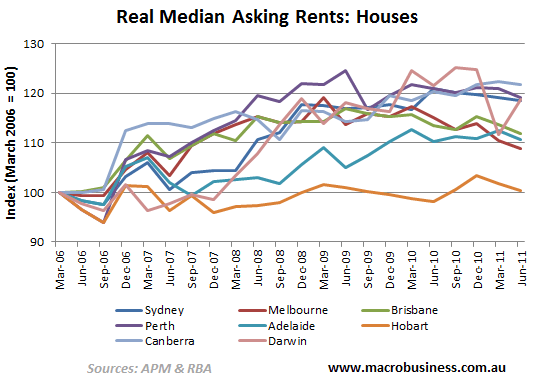
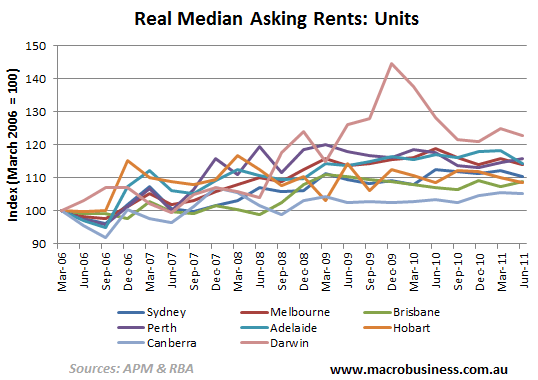
Real Median Asking Rents: APM & RBA


Source: http://www.macrobusiness.com.au/2011/08/more-rent-hysteria/

Thursday, July 28, 2011

Picks

Currently looking into the following:

  • BLT
  • SLT
  • PRR, might buy if a big sell off comes
  • JKA/JKAO - possibly if dip comes

Thursday, July 14, 2011

Stocks under 2c ASX


            Stock             Close             Units                       M/Cap                Sector
1          AAE             0.009             610,842,973             5,497,586.76      Energy
2          AAK             0.002             3,540,224,833             7,080,449.67      Real Estate
3          AAL             0.009             249,705,637             2,247,350.73      Energy
4          AAQ             0.008             418,031,390             3,344,251.12      FBT
5          AAR             0.014             575,768,000             8,060,752.00             Materials
6          ABN             0.001             4,959,473,337             4,959,473.34      Media
7          ACE             0.019             203,683,388             3,869,984.37      Auto
8          ACU             0.002             2,097,095,319             4,194,190.64      Pharma, 
9          AEM             0.008             409,810,055             3,278,480.44             Consumer Services
10         AEX             0.003             1,720,095,042             5,160,285.13             Materials
11         AEZ             0.007             544,910,660             3,814,374.62      Real Estate
12         AFT             0.001             6,715,194,699             6,715,194.70      Capital Goods
13         AGX             0.018             747,331,576             13,451,968.37    Pharma, 
14         ANP             0.009             951,075,212             8,559,676.91      Pharma, 
15         AOM             0.002             2,181,078,901             4,362,157.80             Materials
16         AOP             0.007             699,518,583             4,896,630.08      Pharma, 
17         APB             0.010             1,071,430,635             10,714,306.35             Consumer
18         APP             0.017             60,986,733             1,036,774.46             Diversified Financials
19         ARO             0.003             1,730,034,572             5,190,103.72             Materials
20         ATW             0.014             141,814,736             1,985,406.30      Health
21         AUZ             0.014             576,910,315             8,076,744.41             Materials
22         AVD             0.010             217,676,915             2,176,769.15      Energy
23         AXC             0.015             219,500,000             3,292,500.00             Materials
24         AXM             0.007             5,550,243,713             38,851,705.99             Materials
25         AYG             0.007             1,769,996,234             12,389,973.64    Tech
26         BCD             0.010             951,703,959             9,517,039.59             Materials
27         BCN             0.009             995,073,426             8,955,660.83             Materials
28         BDI             0.011             499,263,377             5,491,897.15             Materials
29         BEC             0.011             1,474,905,353             16,223,958.88    Real Estate
30         BKM             0.006             640,657,733             3,843,946.40             Consumer
31         BKP             0.019             2,065,655,046             39,247,445.87    Energy
32         BLZ             0.002             739,124,444             1,478,248.89             Materials
33         BNE             0.013             111,655,592             1,451,522.70      Pharma, 
34         BNV             0.010             352,200,113             3,522,001.13      FBT
35         BPG             0.002             1,337,048,773             2,674,097.55      Software & Services
36         BPK             0.007             429,466,546             3,006,265.82      Capital Goods
37         BPO             0.008             1,116,570,347             8,932,562.78      Pharma, 
38         BRD             0.008             754,472,951             6,035,783.61             Materials
39         BRO             0.002             552,528,033             1,105,056.07             Telecommunication Services
40         BSI             0.001             3,218,561,308             3,218,561.31             Retailing
41         CDH             0.010             114,608,952             1,146,089.52             Materials
42         CHM             0.005             1,938,138,827             9,690,694.14             Materials
43         CHP             0.018             138,000,000             2,484,000.00             Diversified Financials
44         CIG             0.011             1,331,500,513             14,646,505.64    Energy
45         CNN             0.008             1,341,824,564             10,734,596.51    Capital Goods
46         COJ             0.005             574,667,580             2,873,337.90      Media
47         CVS             0.012             294,271,112             3,531,253.34      FBT
48         CXH             0.015             124,389,433             1,865,841.50      Real Estate
49         CXN             0.009             462,597,018             4,163,373.16             Commercial & Professional Services

Thursday, June 23, 2011

On my radar.....

Currently looking into the following:


  • NAE
  • NXR
  • SLT
  • GMM
Whole market looks sick though.....

Europe worries, US debt, US slowing economy, Greek situation, June selling, Australia two speed economy, falling house prices . etc

Sunday, June 5, 2011

Falling house prices threaten economy


Australian Broadcasting Corporation
Broadcast: 02/06/2011
Reporter: Andrew Robertson

http://www.abc.net.au/lateline/business/items/201106/s3234312.htm

Transcript

TICKY FULLERTON, PRESENTER: Here is a story about Australia's precariously balanced housing market. 

As Australians tighten their belt in the wake of the global financial crisis, house prices are falling. 

It's a situation with serious implications for not just the banks, who are highly leveraged to housing, but for the whole economy. 

Well in a moment we'll be talking in the studio to ANZ Australia's boss Phil Chronican, but first this report from Andrew Robertson. 

ANDREW ROBERTSON, REPORTER: Australia's banks could be sitting on a potential time bomb. Home owners are mortgaged to the hilt and house prices are falling. 

LOUIS CHRISTOPHER, MD, SQM RESEARCH: When we look at the private mortgage debt as a percentage of GDP, we're actually at the same level that Ireland is at, at a private level. Fortunately, at the public level we don't have anywhere near as amount of debt as what they do. 

ANDREW ROBERTSON: According to the Reserve Bank, mortgage debt in Australia, at $1.2 trillion, is roughly the same as the economy's total gross domestic product. It's a big number and the banks are heavily exposed, with home mortgages making up at least half the assets of each of the big four.

Of particular concern is the 20 per cent of the mortgage market who bought their houses in 2009 when interest rates were at record lows. As rates have risen, many of those people are now paying hundreds of dollars a week more and an increasing number are struggling.

SCOTT MANNING, BANKING ANALYST, JP MORGAN: The interest rates are seeing higher delinquency rates come through, so if you look at the level of interest rates today versus two years ago, they are about two, 2.5 per cent higher. And indeed the delinquency rates reported by the major banks have basically doubled over that time. 

ANDREW ROBERTSON: Scott Manning points out from a bank profit point of view, most mortgages are insured. He believes a bigger worry is that households generally are more conservative. 

SCOTT MANNING: We've seen their temporary spending reduced with their retail sales weakness over the last 12 to 18 months. And I think that'll translate into a more permanent rebasing of household expectations through lower gearing tolerance, ie they just won't be willing to borrow as much. 

ANDREW ROBERTSON: And borrowing is the big driver of bank profits. The double whammy for both banks and the economy is that with house prices falling there are a growing number of people whose mortgage is now worth more than their house. 

LOUIS CHRISTOPHER: Being in negative equity means you generally are going to reduce your spending, you're going to try and save more to get yourself out of that position, and that's where you had that multiplier effect in spending for the rest of the economy and why it will actually slow the economy down even further. 

ANDREW ROBERTSON: Louis Christopher is predicting house prices could drop by up to 10 per cent in coming months, with Perth and Brisbane leading the way down. KPMG chief economist Nicki Hutley agrees a 10 per cent fall is feasible and says if that happens the negative impact on the economy will be significant.

NICKI HUTLEY, CHIEF ECONOMIST, KPMG: For every one per cent fall in the value of housing, you're going to get a very small but nevertheless significant fall in consumption, possibly as much as 0.1 of a per cent, which doesn't sound like a lot, but given that consumption's 60 per cent of the economy, that's quite a lot. 

ANDREW ROBERTSON: So a 10 per cent fall in house prices, according to Nicki Hutley, will equate to a one per cent fall in consumption, or in dollar terms well over $10 billion. 

NICKI HUTLEY: We see it's the discretionary spend, whether it's tourism or it's luxury items, that go, not your basics of food and clothing. 

ANDREW ROBERTSON: Which will affect many sectors in the economy and the overall demand for credit, which is one reason why JP Morgan's Scott Manning has revised his outlook for the banks downwards. 

SCOTT MANNING: We can't see at this point any area that will materially benefit their earnings. 

ANDREW ROBERTSON: And Scott Manning is not alone. Bank shares have underperformed the wider stock market over the last 12 months, and with the next movement in interest rates set to be up, that pain for bank investors is set to continue.

Tuesday, May 31, 2011

PRR - Commercialisation in Dubai


CVACTM GRANTED APPROVAL IN DUBAI HEALTHCARE CITY; PRIMA
COMMENCES COMMERCIALIZATION PLANS IN MIDDLE EAST

• First commercial sales of CVac anticipated in 2011

• First approval globally to make CVac commercially available

• Dr Hind Al Saadi appointed General Manager of Prima BioMed Middle East

• Prima to partner with the world-class City Hospital, the first hospital
established in Dubai Healthcare City

• Dubai Healthcare City is the premier hub for medical innovation and patient
care in the Middle East

• Significant opportunity for Prima to tap into US$517 million Middle East
cancer therapy market.

Saturday, May 14, 2011

PRR


http://www.primabiomed.com.au/investor/analyst_reports_pdf/100511_National_Securities_Research_Report.pdf

Sunday, May 8, 2011

Silver Graph

CEO rise

CEO rise (as predicted)..
in excess of 100% rise in the spare price, if you sold at peak.
Don't get left holding at the top..

Thursday, April 14, 2011

April

Hi All,

Thought I should post before I head off to Asia shortly..

Currently, I think the market looks toppy and the overall market may see a pullback..

Stocks I'm either in , or considering entering are:

OROOA - In
DMNOC - In
PRR and PRRO - In & Out multiple times
CEO

Also, keep an eye on Silver prices.. through the roof!


THe two sister plays above (ORO/DMN) have an uP coming drilling program within the next few weeks and are targeting Rare Earth Minerals and/or Gold..

Could be a good play for a bit of movement in speculation of the drilling program (which consists of 2 x 450m drill cores at their Mt Barrett site).

Stay tuned...............

Monday, March 21, 2011

Interested.....

Currently interested in:

AVI
SVL - Silver Mania should be coming up
CEO
ORO - Rare Earth mania coming up (again)

Will post more info shortly

Wednesday, March 2, 2011

NWE

Drilling campaign launched yesterday.. Will it continue to rise?

Tuesday, March 1, 2011

ORO - Oroyo Mining

ORO: is proving to be a busy explorer for 2011.. at $0.006 per share and around 2 billion shares on register, this company has a market cap of approx $12m

Recently the Mt Barrett REE project has engaged a gravity survey to be conducted prior to drilling. Awaiting that, we will then see a drilling campaign to be launched. IN my opinion, this could be a major driver forward for the share price.

Projects (From the Quarterly)

Rare Earths Project (REE) Mt Barrett WA: 100% and diluting to 30% free carry to a decision to mine - 
The Joint Venture Operating Committee has appointed Oroya as the operator of the project. A pre-drilling gravity survey is proposed prior to rig mobilisation in the first quarter of 2011. The total budget for this program including drilling is $450,000. 


Wiagdon Thrust Joint Venture NSW, Gold-Copper Project: Oroya 100% and diluting to 30% free carried to a decision to mine - 
In the coming quarter geochemical sampling is planned to take place in this area in an attempt to reproduce these values and to determine the significance or otherwise of these results. The geochemical soil sampling program is being devised for the anomalous area and sampling on 50m centres is planned to commence in early February 2011. 
An application has been lodged for licence 4134 which adjoins the Windamere area. 
Plans have been prepared to fly close spaced geophysical magnetic and spectral surveys over key areas in the Wiagdon Thrust Joint Venture area. These magnetics will be aimed at locating deep targets. A contract to complete Oroya 
this work will be issued and it is anticipated that flying will take place in the first quarter 2011. 


Moruya Gold Project NSW: Oroya 100% and diluting to 30% free carry to a decision to mine - 
Three of the four Target Areas previously defined have now been identified as “high priority targets” and drill testing is expected in 2011 following-up soil sampling and geological mapping. That three high priority targets are Wagonga (Target Area A), Upper Makins Creek (Target Area B) and Bimbimbie zone of Target Area D. 

Follow-up soil sampling and geological mapping of the highest priority targets will generate drill targets for testing in 2011. Other anomalous areas require further evaluation. 


Pambula Gold Project NSW: Oroya 100% and diluting to 30% free carry to a decision to mine - 
The 2 main target areas are the Wolumla area in Area 1 and the anomalous area west of Pambula. Further drainage sampling is required to fully define these prospective areas. However, it is expected that following this work, soil sampling and mapping will generate drill targets in 2011.


Victoria Gold Projects: Oroya 100% Seeking Farminees - 
Ballarat North, Beaufort, Mt Piper and Club Terrace await review and the preparation of a farmout brochure by the company’s Chief Geologist. 


Roe Hills Nickel Project WA: Oroya 100% - 
On 17 December 2010 Oroya announced to ASX its initial review of the project that confirms significant nickel targets at Roe Hills. This report can be viewed at www.oroya.com.au or at ASX’s company announcement page for ORO. 
The company is preparation for drilling as soon as practical in first half of 2011 after completion of final review by its chief geologist. 


Orbost Copper-Gold Project Victoria: Oroya 100% - 
At the Orbost Copper-Gold Project, in Southeast Victoria near the town of Orbost, four exploration licence applications cover a regional copper metallogenic zone which is prospective for porphyry copper-gold mineralization (Cadis-style). It is anticipated that the tenement applications will be granted in the current quarter. 


Share Price Drivers: Drilling campaign to be commenced on REE at Mount Barrett, Roe Hills Nickel Project drilling plan,


Keep an eye out on this one.. and don't get left holding at the spike.  Again, only in my opinion!